
Maple Heights City Directory Collections
The strongest verified Maple Heights directory run is not a book issued solely under the city name. Cleveland Public Library identifies the Cleveland City Directory Company’s Bedford City Directory as the series that begins including Maple Heights in its 1939 volume. Its guide also distinguishes later East Suburban books, broader Cleveland directories, and address-first criss-cross formats. That distinction matters because each collection answers a different question and a gap in one title is not proof that a person or address was absent.
| Collection | Years | Where Held | Access |
|---|---|---|---|
| Bedford City Directory, Cleveland City Directory Company | 1929, 1931, 1939, 1945, 1948, 1950, 1952, 1954, 1955–56, 1957, 1959–1961, 1963 | Cleveland Public Library History Department | Guide and microfilm; Maple Heights begins in 1939. |
| East Suburban Directory | From 1964 | Cleveland Public Library History Department | Confirm individual Maple Heights coverage before relying on an edition. |
| Cleveland City Directories | 1837–1972, not inclusive | Cuyahoga County Archives | Reading-room or archive request for regional context. |
| Historic appraisal cards | c. 1935–1970 | Cuyahoga County Archives | Address and appraisal context between directory dates. |
| Board of Elections list of electors | 1893–1982 | Cuyahoga County Archives | Historic name-and-place confirmation, subject to current privacy rules. |
The listed Bedford volumes do not form an uninterrupted annual run. Preserve the exact year consulted, and treat an unlisted year as a collection gap. Cleveland Public Library says the separate suburban titles were consolidated into East Suburban and West Suburban directories in 1964, but the exact later Maple Heights volumes were not captured in the research. Ask the library to check the guide or catalog for the particular year.
Bedford Directory Years for Maple Heights
Maple Heights was incorporated as a village in 1915 and became a city in 1932, yet the Bedford directory series does not document its inclusion until 1939. This is a useful local quirk: the city name and the directory coverage do not begin at the same point. A search beginning before 1939 should include Bedford Township, the street name, and any legal-description language available from property material.
| Before 1915 | Search Bedford Township and Cuyahoga County labels, not only Maple Heights. |
|---|---|
| 1915–1931 | Village-era sources may use a different jurisdiction label than later city records. |
| 1932 onward | City of Maple Heights becomes the expected municipal label. |
| 1939 onward | Verified Maple Heights inclusion begins in the Bedford series. |
| From 1964 | Check the East Suburban directory title by title rather than assuming coverage. |
For Maple Heights, County Archives also keeps Cleveland directory volumes from 1837 to 1972, though not every year is present. They can help place a household in the wider metropolitan setting, especially when an earlier family used a Cleveland mailing or business address. The archive’s title changes and the 1888 volume’s 1837 reprint are useful catalog clues, not a promise that every Maple Heights address appears.
Note: The printed jurisdiction, volume title, and date belong in every transcription because Maple Heights and Bedford Township records overlap historically.
Maple Heights Directory Library Access
The local starting point is the Maple Heights Branch of Cuyahoga County Public Library, at 5225 Library Lane. Its stated hours are Monday through Thursday, 9 a.m. to 9 p.m.; Friday and Saturday, 9 a.m. to 5:30 p.m.; and Sunday, 1 p.m. to 5 p.m. Branch staff can route a directory or criss-cross question to the relevant CCPL or Cleveland Public Library history holding. The branch also provides a path to genealogy resources such as HeritageQuest, FamilySearch content, Ohio Memory, and Sanborn Fire Insurance Maps.
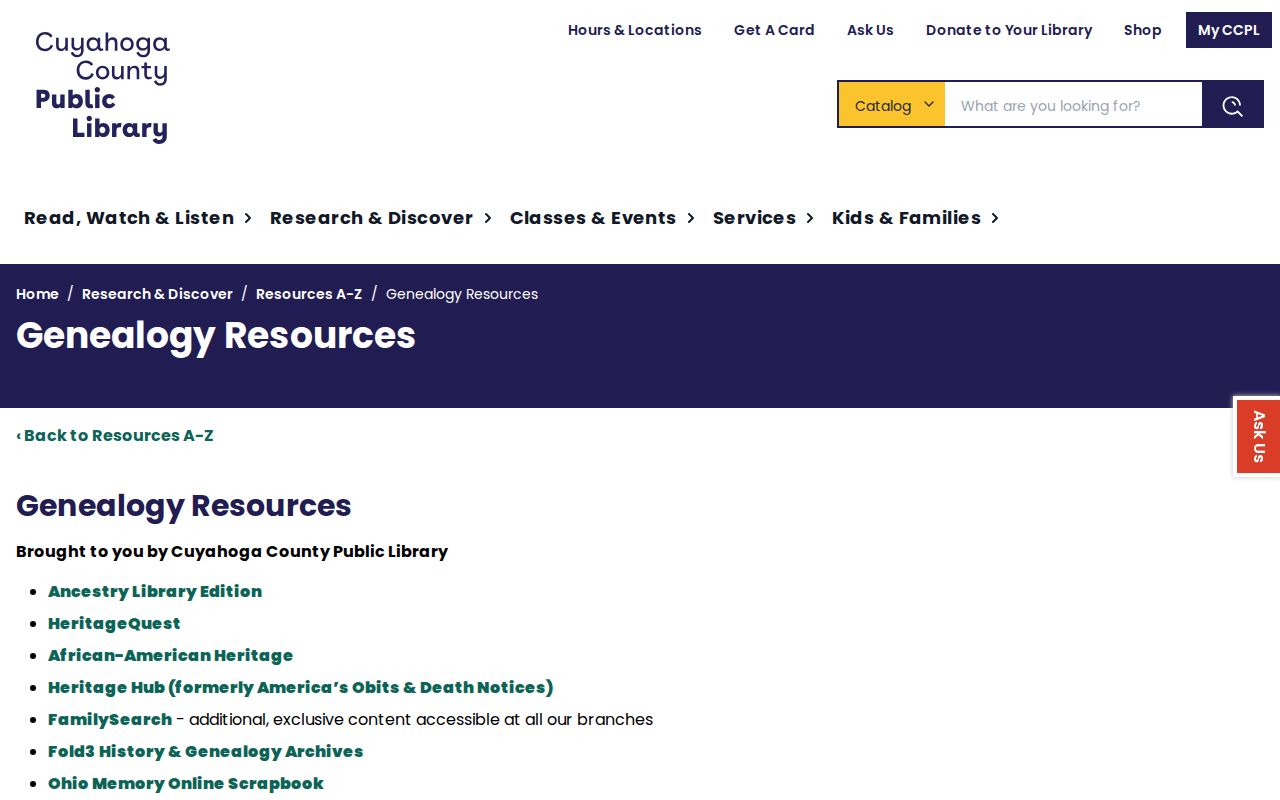
The CCPL genealogy resources page documents those research channels and distinguishes in-library access from remote access. Its screenshot is a useful reminder to ask what can be opened at a branch before making a trip for a directory search.
Use a bounded request: give the directory year, surname variants, a street address if known, and whether an alphabetical or criss-cross section is needed. For County Archives, add the desired record group, such as a tax duplicate, map, estate index, election list, or directory. The Archives asks email and mail requesters to include the record type, surname, relevant dates, and any known page, volume, or petition number; its stated response target is within three weeks when enough detail is supplied.
Read a Maple Heights Directory Entry
A Maple Heights directory entry is a dated transcription, not a complete biography or a title record. Open the abbreviations page in the same volume before interpreting a mark. Cleveland directory conventions changed over time: the guide notes that wives’ names began appearing in the Cleveland directory in 1929, while earlier issues commonly used widow and certain single-woman notations. Copy what appears on the page, including odd spelling and punctuation.
| Printed name | Surname, given name or initial, and any middle initial used in that edition. |
|---|---|
| Family notation | A spouse in parentheses or a widow notation, when the volume prints one. |
| Address | Street number, street name, and any rear or apartment notation shown. |
| Listing detail | Any affiliation or other descriptor printed beside the name, copied exactly. |
| Source citation | Directory year, publisher or title, page or column, and neighboring entries. |
- Criss-cross directory
- An address-first directory that normally leads from a street number to an associated listed name for a particular edition.
- Householder index
- An alphabetical listing that can provide the corresponding name entry after an address-first lead is found.
- Abbreviation key
- The volume’s own explanation of its shorthand. Preserve it with the entry because meanings can change among editions.
A listed address connects a person to a date, but it does not establish ownership or identify every person who was present there. That limit is why the directory citation needs a separate property or household check.
Criss-Cross Maple Heights Directory Searches
When the starting point is an old address, a criss-cross or reverse directory is the useful format because it sorts by street address rather than name. Cleveland Public Library’s guide treats city, criss-cross, and telephone directories as different formats. First confirm the street number and edition, then write down the address, printed name, page, and spelling before moving to the alphabetical entry. A modern parcel search can provide the current number, but older names and descriptions may not match it exactly.
The Cleveland Public Library digitized city-directory route is a catalog and collection lead rather than proof of a complete online Maple Heights run. Use the directory material with its stated format and date. The full modern by-address chain is handled on the Maple Heights street directory page, where parcel and recorded-document steps are the main focus.
After an address-first result, check the alphabetical entry in the same edition. It may confirm initials, family notation, another address clue, or a spelling variant. Then compare the next available edition, not an assumed annual sequence, and label each observation with its source year.
Trace Maple Heights Directory Volumes
Family-history work gains strength when a directory is used as a series of dated observations. A name’s first appearance, changed street number, or disappearance can suggest a move, death, different spelling, or an edition gap. It does not settle which explanation is correct. Pair the date-specific listing with the federal census, property material, obituary index, or Probate records that address the next question.
- Choose the closest verified Bedford or broader Cleveland directory year and copy the name, address, page, and title exactly.
- Check the next earlier and next later available editions, marking true gaps in the run rather than filling them with assumptions.
- Use a criss-cross section, where available, to test the same dated address and then return to the alphabetical entry.
- Pair a directory lead with the matching released federal census year. The 1950 census is the most recent complete decennial census open under the National Archives’ 72-year release schedule.
- Test a move or address change with a deed transfer, tax or appraisal card, obituary, or Probate estate file, depending on the date.
The County Archives holds supporting groups that help resolve those leads: births from 1849–1908, deaths from 1840–1908, marriage records from 1810–1941 with later index access, estate files from 1813–1918, and naturalization materials. Give the archive the narrowest possible year span. A directory match should be described as a listing in that edition, not as a permanent household finding.
Maple Heights Schoolhouse Collection Leads
The Maple Heights Historical Society’s Little Red Schoolhouse Museum adds local context that a printed directory does not carry. The City Resident Guide describes it as an 1871 former one-room schoolhouse with City Hall, police, fire, public-school, civic, church, fraternal, founder, and local-business memorabilia. It also lists 23 Maple Heights High School graduating-class composite photographs beginning with the class of 1926. These categories can turn a family story into a focused request for a school, church, group, founder, or year.
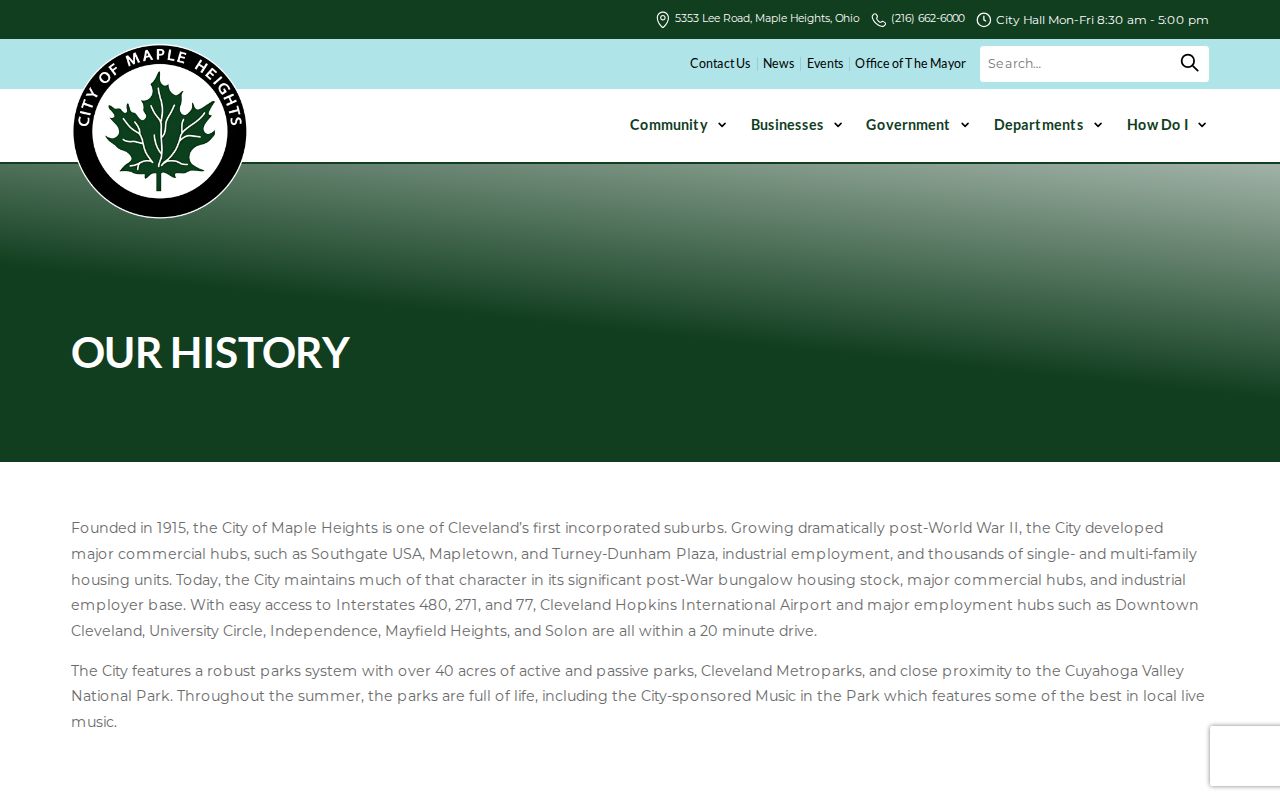
The City’s history timeline preserves the local transition from Bedford Township to the village and then the city. That historical context matters when a directory or map uses a place label that differs from the current one.
Visits to the Schoolhouse are by appointment on Monday or Wednesday evenings from June through September, 7–9 p.m., according to the Resident Guide. The guide gives 216-215-5982 and hgyekenyesi@gmail.com. Confirm current arrangements before visiting, then corroborate dates and property facts through the library, County Archives, Recorder, or a dated directory.
Match Maple Heights Directories to Parcels
A directory is strongest when it becomes one part of a dated record trail. For a Maple Heights address, use the Cuyahoga County MyPlace parcel card to identify the parcel number and current address context, then use the Recorder’s instrument index to test recorded transfers. MyPlace is a county convenience service and says it is not the official record. The Recorder document, its recorded date, and the legal description carry the formal land-record weight.
County Archives provides the older fallback: original map volumes cover roughly 1860–1945, tax records cover about 1819–1986, and historic appraisal cards cover about 1935–1970. Property research is appointment-only. Street names, dimensions, and legal descriptions can change, so save the source date and the wording in each record instead of forcing old material into a modern address.
Note: A city-directory listing, parcel card, recorded document, and archive map answer different questions and should remain separately cited.